

Arsenal delivered one of their strongest European performances under Mikel Arteta on Wednesday night, defeating Bayern Munich 3–1 at the Emirates Stadium in a match defined by intensity, tactical discipline, and clinical finishing. The win not only secured Arsenal’s fifth victory in five Champions League group-stage games, but also sent a message across Europe: the Gunners are no longer hopefuls — they are contenders.
From the first whistle, we played with both authority and respect for the occasion. Bayern arrived with one of the strongest squads in Europe, but Arteta’s side approached the match with clear intent: dominate the ball, win second balls, and suffocate Bayern’s build-up.
Declan Rice set the tone early, snapping into duels and recycling possession quickly. Mikel Merino orchestrated between the lines, drifting into pockets that troubled Bayern’s midfield shape alongside Saka, doing the holdup play mostly. Arsenal’s early pressure paid off.
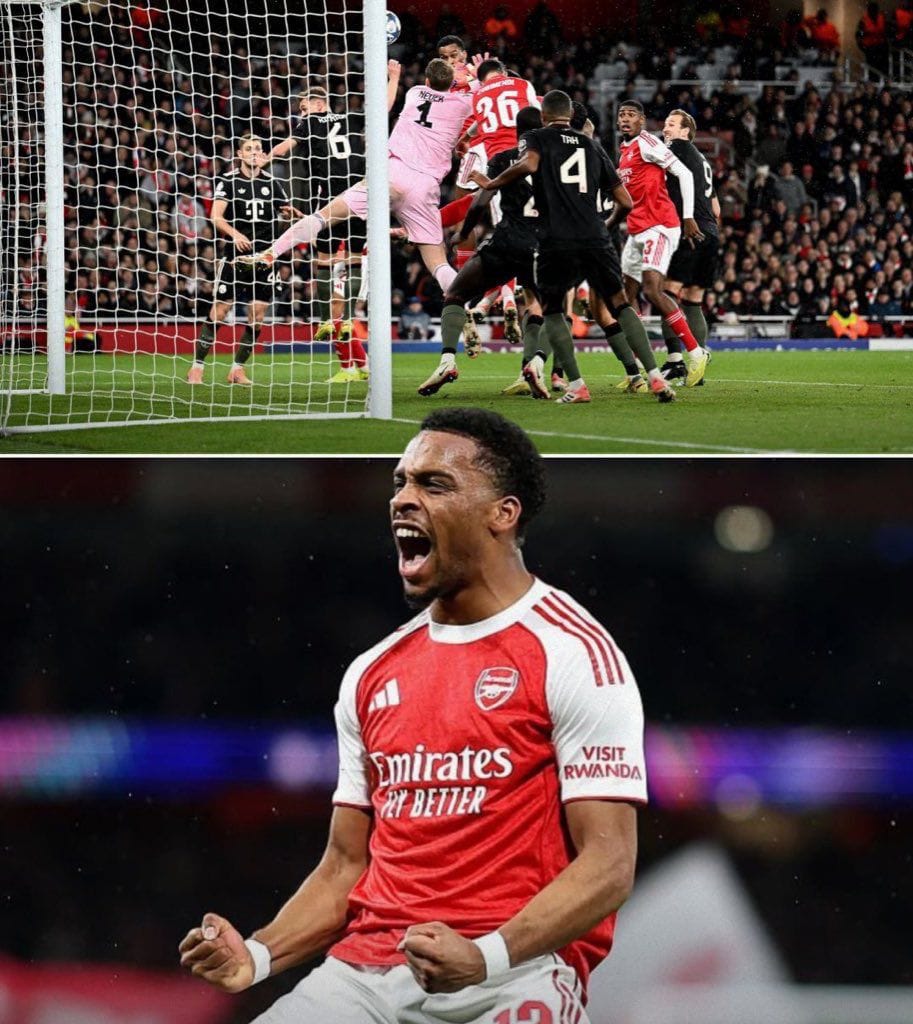
The opening goal came in the 22nd minute from a set-piece — an area Arsenal have quietly become elite at. Bukayo Saka whipped in a pinpoint corner, and Jurrien Timber, rising above two Bayern defenders, powered a header home.
For a defender making his way back from a long-term injury, it was more than just a goal — it was a statement of his growing influence on this team. Arsenal went ahead, and the Emirates roared.
Despite Arsenal’s momentum, Bayern found their equaliser through 17-year-old prodigy Lennart Karl. The youngster — playing with the confidence of a seasoned professional — finished off a swift Bayern move that sliced through Arsenal’s midfield for the first time in the half.
It was a reminder that Bayern, regardless of form or absentees, possesses players who can punish the smallest lapse. The goal sharpened Arsenal’s focus but also gave Bayern belief as the half closed.
The second half showcased the best of Arteta’s modern Arsenal: patience, structure, collective pressing, and tactical bravery.
Arteta introduced fresh legs early enough, and the energy shift was immediate. The team pressed higher, circulated the ball quickly, and pinned Bayern into increasingly uncomfortable areas.
The breakthrough arrived in the 69th minute. After sustained pressure, the ball fell to Noni Madueke, who produced one of the most decisive moments of the match. Powering in Calafiori's ball across the goal after another defensive lapse from the Bayern defenders.
Madueke’s introduction changed the rhythm of the game. His directness unsettled Bayern’s defensive block, and his goal re-established Arsenal’s lead at a crucial moment.
As Bayern pushed forward seeking a second equaliser, their defensive line began to stretch. Arsenal capitalised ruthlessly.
In the 76th minute, a loose Bayern touch opened the door for Arsenal. Gabriel Martinelli raced onto the ball, drove into open space, and moved past Neuer, who was caught in no man's land, to put the ball into an empty net calmly.
It was the kind of goal Arsenal often conceded in years past — but now they scored it. Efficient, devastating, and decisive. The Emirates erupted, sensing that the job was nearly done.
Tactical Notes: How Arsenal Outclassed Bayern
1. Midfield Balance and Defensive Control
Rice and Zubimendi controlled the tempo and clogged Bayern’s central channels. When Bayern attempted to overload wide areas, Arsenal’s wingers tracked back diligently, forming a compact block that limited their rhythm.
2. Pressing Triggers Executed with Precision
Arteta’s press was especially effective after halftime. Arsenal waited for specific Bayern passes into midfield before collapsing on the ball. This created turnovers — and eventually goals.
3. Substitutions That Shifted the Momentum
Second-half substitutions’ impact cannot be overstated. Their presence stretched Bayern vertically and forced their defensive line deeper, creating space for Ødegaard and Madueke to operate.
4. Psychological Growth and Game Management
Perhaps the biggest improvement: Arsenal did not panic after Bayern scored. They stayed structured, stuck to their principles, and grew stronger as the match went on — a sign of maturity in Europe.
What This Result Means for Arsenal
- Five wins from five in their group.
- Control of the top spot with authority.
- A victory over a traditional European powerhouse — not by luck, but by dominance.
- Tactical evolution on full display.
- A squad showing depth, resilience, and increasing confidence.
It also marks the first time in years that Arsenal have beaten Bayern in a meaningful European match in a fashion that looked sustainable, repeatable, and deserved.
Arsenal’s 3–1 victory was more than just a group-stage win — it was a declaration that the club has crossed a threshold. The stadium atmosphere, the performance quality, the tactical intelligence, and the ruthless finishing all pointed toward a team ready to compete with Europe’s elite.
COYG.