
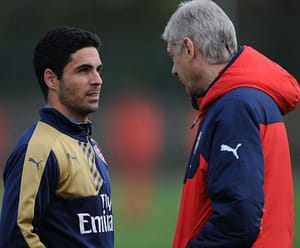
Over the last 6–8 weeks, there’s been a noticeable shift in Arsenal’s structure and in-game management. Rather than a dramatic overhaul, Mikel Arteta has introduced targeted refinements designed to address the recurring issues that plagued earlier stretches of the season: sterile dominance, second-half drop-offs, unreliable centre-forward output, late-game fragility, and defensive strain due to injuries.
Here’s how those fixes are manifesting on the pitch.
From Sterile Possession to Vertical Incision
Problem: High possession, low penetration against compact blocks.
Earlier in the season, Arsenal could dominate territory without generating a sustained threat. Circulation was safe, controlled — but often predictable.
Adjustment: Quicker vertical access after regains.
- Declan Rice and Martin Zubimendi are stepping higher in possession, forming aggressive 3-2-5 or even 3-1-6 structures.
- Martin Ødegaard and Eberechi Eze are encouraged to attempt earlier through-balls rather than recycling.
- Wide players attack the half-spaces more decisively.
- Saka.
Impact:
We’ll be seeing more third-man runs and midfielders arriving in the box. The team is creating chances earlier in sequences instead of exhausting the block first. Possession is now a weapon, not an end in itself. Saka playing the No. 10 role gives the team a different dynamic and is less predictable.
Second-Half Game Control & Energy Injection
Problem: Momentum swings after halftime; visible drop in intensity.
Arsenal had a pattern of leading but failing to sustain pressure in the second half.
Adjustment: Structured intervention points.
- A proactive “energy sub” between 55–65 minutes (often Martinelli or Trossard) to reset pressing intensity.
- More coordinated pressing triggers — pressing in waves rather than individual chasing.
- Clearer compact mid-block when protecting a lead instead of continuing full territorial dominance.
Impact:
Recent matches — including the win over Sunderland and the Carabao Cup semi-final second leg — have shown improved control and fewer chaotic spells after halftime, but were not present in the last two Premier League games.
Centre-Forward Fluidity Instead of Dependency
Problem: Overreliance on a traditional No.9 to generate output.
Arsenal’s earlier structure required the striker to link play, occupy defenders, and finish — a heavy burden that often stalled attacking rhythm.
Adjustment: Rotational front-line dynamics.
- Viktor Gyökeres, Gabriel Jesus, and Kai Havertz interchange roles more fluidly.
- Greater emphasis on “arriving” goal threats from midfield (Eze, Ødegaard, Rice).
- Increased support runs around the striker rather than isolating him centrally.
Impact:
Chance creation is less predictable and less centralised. The striker’s role is becoming catalytic rather than purely productive — and that diversification reduces tactical stagnation.
Defensive Stability Amid Injuries
Problem: Structural vulnerability due to absences in the back line.
Injuries could have destabilised Arsenal’s defensive identity. Instead, Arteta has leaned into structural adaptability.
Adjustment: Hybrid defensive layering.
- Jurrien Timber and Riccardo Calafiori operate as inverted or hybrid full-backs, tucking inside to create situational back threes.
- Rice occasionally drops between centre-backs to stabilise build-up and defensive transitions.
- Rotational functionality over fixed positional rigidity.
Impact:
Despite personnel disruption, Arsenal remain statistically among Europe’s strongest defensive units — evidence of systemic resilience rather than individual dependency.
Late-Game Emotional Management
Problem: Conceding late goals and visible anxiety in the closing stages.
Earlier in the season, Arsenal’s control deteriorated under pressure. Leads felt fragile.
Adjustment: Deliberate game-state governance.
- Compact mid-block when leading rather than continuing aggressive territorial expansion.
- Earlier introduction of stabilising players (e.g., Nørgaard, Havertz).
- Public emphasis from Arteta on “emotional control” and collective composure.
Impact:
The approach is less expansive but more pragmatic when protecting margins. The objective has shifted from aesthetic dominance to controlled closure.
Overall Assessment
Arteta is not revolutionising Arsenal mid-season. He is recalibrating.
The team is evolving from rigid positional dominance toward a more fluid, vertical, and adaptable system while preserving its defensive foundation. The adjustments are visible, but still bedding in.
The decisive question now is not tactical imagination — it’s consistency under fatigue and pressure, particularly in the final 15 minutes of high-stakes matches.
If these refinements stabilise over the next month, Arsenal will not just be contenders — they will be formidable.
The evolution is deliberate.
Now it needs to be decisive.
COYG.