
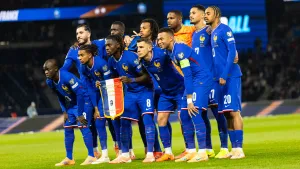
The "Last Dance" narrative in football is often reserved for aging strikers or midfield maestros, but in the case of the French National Team, this spotlight is firmly on the dugout. As Les Bleus prepare for the 2026 World Cup across Canada, Mexico, and the United States, they do so with a roster that looks vastly different from the one that lifted the trophy in Moscow or fell agonizingly short in Qatar.
This is the definitive preview of a nation that remains the gold standard of talent production, coached by a man looking to close the book on a 14-year odyssey.
Part I: The Roster — A Changing of the Guard
The Official France Squad for the March 2026 International Break offers the clearest glimpse yet of the hierarchy Didier Deschamps has established for the summer. While the captain’s armband remains firmly on the sleeve of Kylian Mbappé, the supporting cast has undergone a necessary evolution following the international retirements of legends like Olivier Giroud, Antoine Griezmann, and Raphaël Varane.
The Missing Pillars and the Injured XI
The March window was notable for the absence of Aurélien Tchouaméni and William Saliba, both of whom are recovering from minor muscle strains. Their inclusion in the final June squad is non-negotiable; Saliba has ascended to become the world’s premier "preventative" defender, while Tchouaméni remains the tactical anchor of the midfield.
The Late Claimants: The Mayulu Factor
Deschamps has a history of taking a "wildcard" youngster to major tournaments (think Mbappé in 2018 or Camavinga in 2022). This year, the name on everyone’s lips is Senny Mayulu.
- The Profile: The PSG breakout star offers a profile France has lacked since Griezmann’s departure: a high-volume creative hub who can operate in the "half-spaces."
- The Competition: Mayulu is competing with Michael Olise and Bradley Barcola for those final attacking slots. His performance in the March friendlies—notably his assist against Germany—suggests he is no longer just a prospect, but a genuine contender.
- Other Breakouts: Keep an eye on Leny Yoro, whose ball-carrying stats from the back have added a new dimension to France’s buildup play.
Part II: The Deschamps Doctrine — Pragmatism Over Dogma
Didier Deschamps’ tenure (2012–2026) will be studied for decades as a masterclass in "International Pragmatism." He has never been a coach of rigid positional play; instead, he is a manager of moments and psychological resilience.
The Tactical Breakdown: The Hybrid 4-3-3
Under Deschamps, France typically defends in a compact 4-4-2 block but transitions into a fluid 4-3-3 or 4-2-3-1.
- Rest Defense: France consistently ranks in the 90th percentile for "Interceptions in the Defensive Third." Deschamps prioritizes a low-risk structure that allows his front three to stay high and wide, ready to punish teams on the break.
- The "Engine Room" Data: Since 2024, the trio of Warren Zaïre-Emery, Eduardo Camavinga, and a fit Tchouaméni has averaged a combined 14.2 ball recoveries per 90 minutes. This physical dominance allows France to weather storms and strike with "verticality"—a hallmark of Deschamps’ successful 2018 campaign.
Success and the "Final Hurrah"
With a World Cup (2018) and a Nations League (2021) title already in his cabinet, Deschamps is chasing the only thing that would make him the undisputed greatest international manager of the modern era: a second World Cup. Having confirmed this tournament will be his last, the squad is playing with the motivation of a "Farewell Tour" for the man who rebuilt French football from the ashes of Knysna 2010.
Part III: The North American Odyssey — Path to the Final
According to FIFA.com's official 2026 World Cup Match Schedule, France is expected to enter as a Pot 1 seed, likely based in the Western United States/Mexico hubs for the group stages to avoid the humidity of the East Coast.
The Group Stage and Logistics
As the top seed in Group C, France’s primary challenge will be the logistical fatigue of travel. However, their depth—arguably the deepest in the world—allows for heavy rotation in the third group game, a tactic Deschamps has used effectively in every tournament since 2014.
The Path to MetLife Stadium
- Round of 32/16: Projections suggest a collision course with a runner-up from Group D or B. This could mean an early, high-stakes clash against a stuttering USA or a tricky Denmark side.
- The Semi-Finals: If the bracket holds, a rematch of the 2022 Final against Argentina looms in the semifinals in Dallas.
The Verdict: Can they do it?
Chances of Winning: 19% (Joint Favourites with Brazil) France remains the most "tournament-ready" squad in the world. They do not need to dominate the ball to dominate the game. With Mbappé at the peak of his powers (age 27) and a midfield that is both young and experienced, anything less than a semi-final appearance would be considered a national failure.
Sources & Citations
- FFF Official:Equipe de France - March 2026 Selection
- FIFA:2026 World Cup Tournament Regulations and Path Brackets
- Opta Sports / The Athletic FC Analytics: Data on Deschamps' tactical win-rate and "Vertical Progression" metrics (2022-2026).
- L’Équipe: Report on Senny Mayulu’s training camp performance (March 28, 2026).