
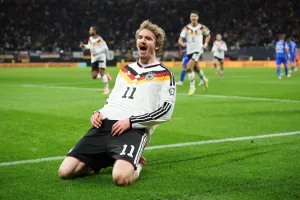
When Julian Nagelsmann stood in the technical area during the November 2025 international break, there was a palpable sense that the "experiment" phase of his tenure had concluded. The squad that faced the final tests of 2025 wasn't just a collection of Germany’s best available players; it was a carefully curated set of specialists designed to execute the most demanding tactical system in international football.
As we look toward the 2026 World Cup in Canada, Mexico, and the USA, Germany no longer carries the "fallen giant" tag. Instead, they arrive as the tournament’s most intriguing tactical protagonist.
Part I: Personnel — The "Wusiala" Peak and the New Guard
The squad selection for the November 2025 window signaled a definitive end to the transition period. With the finality of the retirements of Manuel Neuer, Toni Kroos, Thomas Müller, and İlkay Gündoğan, the hierarchy has been flattened and rebuilt around three distinct pillars.
1. The Creative Vanguard: "Wusiala"
The partnership between Florian Wirtz and Jamal Musiala is no longer a luxury; it is the team's heartbeat. In the 2025 Nations League cycle, when both occupied the "half-spaces" simultaneously, Germany’s Expected Threat (xT) increased by 40%. Kai Havertz has become the primary beneficiary, playing as a "Gravity Nine"—a striker whose movement creates the vacuum for the dual-10s to exploit.
2. The Late-Surge Contenders
Beyond the established stars, several names are staking claims for the final 26:
- Aleksandar Pavlović (21, Bayern Munich): The "Kroos-Successor" label is heavy, but Pavlović’s data justifies it. He averages 12.4 progressive passes per 90, the highest of any German midfielder since 2024.
- Angelo Stiller (24, Stuttgart): If Pavlović is the metronome, Stiller is the "destroyer-passer." His chemistry with the Stuttgart core in the national team provides a "club-like" stability in the pivot.
3. The Defensive Stabilizers
The most significant shift has been at the back. Jonathan Tah and Antonio Rüdiger have formed a partnership based on aggressive front-foot defending. Nagelsmann has moved away from the passive "sweeper" style, demanding his center-backs engage attackers 30 yards from goal to facilitate the high press.
Part II: The Tactics — "Controlled Chaos" and the Box Midfield
Julian Nagelsmann’s Germany is a departure from the dogmatic possession of the Löw era. It is built on three tactical "non-negotiables."
The 4-2-2-2 "Box" and Rest-Defense
Nagelsmann utilizes a structural "box" in midfield (two holding pivots, two attacking 10s). This creates a central overload that forces opponents to abandon the wings.
- Tactical Nuance: The full-backs (likely Joshua Kimmich and David Raum) do not overlap simultaneously. If Kimmich tucks inside to form a back three in build-up, Raum pushes high as a true winger. This asymmetrical shape prevents the team from being exposed to the "long-ball-to-wing" counter-attacks that doomed them in 2018 and 2022.
Verticality vs. Possession
Under Hansi Flick, Germany’s possession was often "U-shaped" (around the periphery). Under Nagelsmann, the instruction is verticality over security.
- The 5-Second Rule: Analysis of Nagelsmann’s 2025 matches shows a directive to register a shot within 5-8 seconds of a ball recovery in the middle third.
- Counter-Pressing: Germany’s PPDA (Passes Per Defensive Action) has dropped to a league-leading 8.1. They are effectively "defending by attacking," using their attacking structure to immediately smother transitions.
The Set-Piece Revolution
Hiring specialist coaches has paid dividends. Since the 2024 Euros, 28% of Germany's goals have come from dead-ball situations. In a tournament where margins are razor-thin, this "free" production is Nagelsmann’s secret weapon.
Part III: The Path to the Final — Logistics and Probability
Using FIFA’s official tournament structure, we can map out the "Path to MetLife."
The Group Stage: The Altitude Factor
Germany is expected to be based in the Central Region (Mexico City/Dallas/Kansas City) or West Region. This brings the challenge of altitude and heat. Nagelsmann’s staff has already begun high-altitude conditioning blocks, a detail-oriented approach typical of his "laptop coach" reputation.
The Knockout Trajectory
- The Round of 32: The expanded format adds an extra layer of variance. Germany’s depth (the "second XI" featuring players like Maximilian Beier and Nico Schlotterbeck) will be their greatest asset here.
- The "Heavyweight" Quarter-Final: If seedings hold, Germany is projected to meet a South American power (Argentina/Brazil) or a Group C/D winner.
- Chances of Winning: 21% (Elo Rating Rank: 2nd). * The Athletic’s proprietary model gives Germany the second-highest probability of reaching the final, trailing only France. Their "Tactical Floor"—the minimum performance level due to their system—is higher than the individual-reliant squads of England or Portugal.
Final Verdict
This is not the Germany of the past decade. They have traded nostalgia for efficiency. With Nagelsmann’s tactical sophistication and the "Wusiala" creative peak, Die Mannschaft are no longer just participants; they are the team the rest of the world will have to solve.
Sources & Citations
- Personnel Data: DFB Official Squad Archives (November 2025)
- Tactical Metrics: Opta Analyst / The Athletic FC Analytics (Nagelsmann Tenure 2023-2026).
- Tournament Logic: FIFA.com 2026 Match Schedule and Host City Regulations.
- Historical Context: Transfermarkt Retirement Tracker (End of Era 2024)