
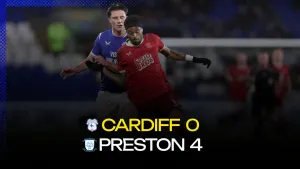
Preston North End ended Cardiff City’s unbeaten home league run with a ruthless 4-0 win at the Cardiff City Stadium.
Thierry Small, Alfie Devine, Andrew Moran and Andrew Hughes scored for the visitors, who arrived in South Wales without an away win this season and sitting bottom of the Championship. Yet Graham Alexander’s side were sharper, more disciplined and far more clinical than a Cardiff team which never recovered from a poor first half.
The final score was brutal, but it reflected the decisive difference between possession and threat. Cardiff had 72% of the ball and matched Preston for shots, but their 0.71 expected goals told the real story. Preston created better chances, forced repeated errors in Cardiff’s build-up, and exposed the defensive fragility that has become an increasingly worrying feature of recent results.
An Early Warning
Cardiff might have taken the lead inside four minutes. Jack Moylan found himself with what appeared to be an open goal after a promising move, only for Liam Lindsay to produce an excellent last-ditch block. It was a rare moment in which Preston’s defensive shape was genuinely stretched.
Instead of building on that start, Cardiff’s passing became increasingly loose and their normally fluid attacking football was blunted by Preston’s compact 3-4-2-1 system. Alexander’s side allowed Cardiff to have possession in harmless areas but shut off the routes into Yousef Salech and Moylan, forcing the Bluebirds wide or backwards.
Preston began to grow into the match through Moran and Devine, with the former forcing Nathan Trott to punch away a dipping effort. Cardiff had plenty of the ball, but the visitors increasingly controlled the rhythm. There was no sustained pressure, no clear sequence of chances, and little evidence that Preston’s goalkeeper, Luke Nicholls, would be properly tested.
Small Exploits Cardiff’s Back Post
The breakthrough came in the 27th minute. Stan Mills’ low cross from the right travelled through Cardiff’s defence and found Small arriving at the back post, where he converted to give Preston the lead.
It was a disappointing goal to concede because the danger was visible from the moment Mills received the ball. Cardiff had not dealt with the cross, had not covered the far post and were punished by a Preston side which had shown little attacking threat in the opening quarter.
That goal changed the contest. Cardiff had been uncomfortable before it, but they now looked hurried and vulnerable. Preston sensed that the hosts’ confidence had dipped, and they pressed more aggressively when Cardiff tried to play out from the back.
Thierry kicking things off with a perfect first-time finish. 💥 #pnefc https://t.co/QI0OZeVgD8
— Preston North End FC (@pnefc) November 25, 2026
Kpakio Error Leaves Cardiff With a Mountain to Climb
The second goal was even more damaging. Moran won possession from Ronan Kpakio around 30 yards from goal, drove into space and picked out Devine, who calmly found the bottom corner beyond Trott.
Kpakio had been exposed by Preston’s press and paid a heavy price for losing the ball in a dangerous area. It was a harsh lesson for the young defender, but one which also reflected a wider Cardiff problem. They continued to attempt ambitious passes under pressure without providing the receiver with enough support or a safe route out.
Trott was left helpless by both first-half goals, while Salech was isolated at the other end and Moylan could not find the spaces which had made him so influential earlier in the season. Ollie Tanner had one effort dealt with late in the half, but Cardiff went in two down after what was unquestionably their poorest home half of the campaign.
Alfie Devine olé olé 🎶 Such a satisfying finish 🤌 #pnefc https://t.co/YWP62FjjxE
— Preston North End FC (@pnefc) November 25, 2026
Possession Without Purpose
Cardiff made a half-time change, with Joel Colwill replacing Kpakio, and began the second period with more urgency. Tanner and Rubin Colwill both shot wide, but the improvement was fleeting. Preston remained the better-connected team, more secure without the ball and more direct when they won it.
The statistics underlined the problem. Cardiff finished with 72% possession and 14 shots, but only five were on target, and the majority came from outside the penalty area. Preston, by contrast, created four big chances and generated 2.31 expected goals [xG] despite having only 28% of the ball.
There is nothing inherently wrong with Cardiff dominating possession. Barry-Murphy’s approach is built on using the ball aggressively and progressing quickly through the thirds. But it only works when the technical execution and decision-making match the ambition. On this occasion, Cardiff’s possession simply created more opportunities for Preston to spring their press.
Willock’s Error Opens the Door Again
The third goal ended any realistic prospect of a comeback. Chris Willock, introduced only minutes earlier, attempted a pass towards Colwill around 30 yards from Cardiff’s own goal but failed to make the pass connect. Moran collected the loose ball, drove forward and struck an effort which took a deflection off Joel Bagan before looping over Trott.
It was an unfortunate deflection, but the sequence again began with a needless turnover in a damaging area. Cardiff had not been undone by a sustained Preston assault; they had repeatedly handed the visitors the moments they needed.
That is what made the performance so alarming. Preston were organised, disciplined and deserved full credit for how they executed Alexander’s plan, but Cardiff made their task far easier than it should have been. They were not simply beaten by a better team; they played a major role in their own downfall.
Boy did he enjoy that one! 🤩 Andy Moran sealing the +3 🙌 #pnefc https://t.co/llYLBnEbWe
— Preston North End FC (@pnefc) November 25, 2026
Hughes Makes It Four
Preston’s fourth arrived six minutes later. Hughes rose above Bagan and Rubin Colwill from a corner and headed home, completing a night in which Cardiff struggled at both ends of the pitch.
Rubin remained willing to take responsibility in possession and continued to search for a way through, but he could not impose himself in the same manner he had for Wales during the international break. Cardiff’s attacking players had neither the service nor the sharpness to change the shape of the match, while the defensive unit looked increasingly vulnerable whenever Preston entered their half.
By the closing stages, the contest had become one of damage limitation. Cardiff continued to circulate the ball, but there was little conviction that a goal was coming. Preston, buoyed by a first away win of the season, were comfortable enough to protect their clean sheet and could even have added to the scoreline.
Hughesy with a hometown goal to put the icing on the cake. 🏴 #pnefc https://t.co/ucYcsYOnb5
— Preston North End FC (@pnefc) November 25, 2026
What the Defeat Means
This was a major setback, not simply because of the scoreline but because it brought to an end Cardiff’s home record against a side who had been bottom of the division.
Barry-Murphy was right to say Cardiff must “own the result and own that performance”. There was no hiding behind bad luck, refereeing decisions or a single isolated mistake. The Bluebirds gave the ball away too often, failed to defend key moments and offered too little attacking threat despite having the bulk of possession.
The timing could hardly be worse. Cardiff now have only a few days to regroup before Sunday’s South Wales derby against Swansea City. That game offers an immediate chance to respond, but it will also demand a much greater level of composure, competitiveness and defensive accountability than this display provided.